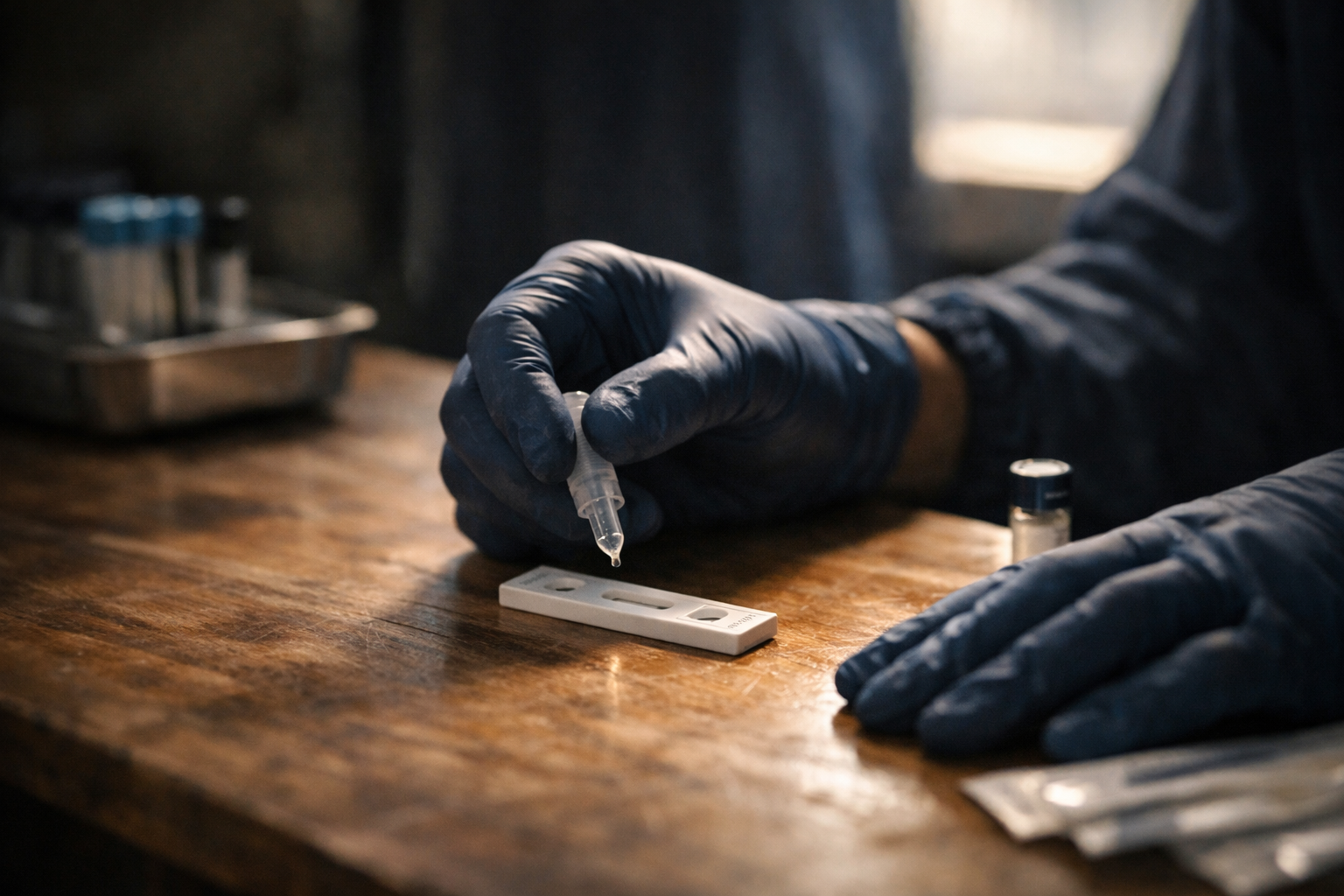
The North American Syringe Exchange Network has operated a buyers' club for harm reduction supplies for years. As of October 2025, the network reports roughly 582 syringe service programs participating, a near-doubling from the figure published two years earlier. For drug-checking-strip distribution, this is the most consequential shift in the harm reduction supply chain since opioid settlement funds began flowing.
The reason is structural. A national syringe service program network with 582 active sites does not just move syringes. It moves anything that fits in the same shipping unit, including test strips, naloxone, sterile water, and the smaller-volume supplies (cookers, cottons, mouthpieces) that round out a harm reduction kit. NASEN's role as an aggregator turns 582 small purchase orders into a smaller number of large purchase orders, which changes the unit economics of the supply chain.
What aggregation does to the procurement math
Three things, mainly:
- Lower unit cost at the supplier side, because production runs are sized for one large order rather than dozens of small ones.
- Faster fulfillment for the program, because the buyers' club holds inventory that an individual SSP would need to wait for.
- More consistent specification across sites, because the network can negotiate one set of product specs rather than have each site negotiate its own.
The third point is more important than it sounds. When 582 programs all use the same fentanyl strip from the same lot, training materials transfer, troubleshooting transfers, and the surveillance data they produce is comparable across the network. When each program runs a different strip, none of that holds.
What aggregation does not do
Aggregation does not solve the legal-authorization question in states that still treat newer strip types ambiguously. A buyers' club can ship a medetomidine strip into any state where it is lawful to do so. Whether the receiving SSP can lawfully distribute it is a state-by-state determination that NASEN cannot resolve on the supplier's behalf.
Aggregation also does not solve the funding question. NASEN's buyers' club model lowers the per-unit cost of strips, but it does not put dollars in a program's account. Settlement funds, SAMHSA grants, State Opioid Response (SOR) money, and private philanthropy still need to do that work. What aggregation does is stretch the dollars further once they arrive.
The buyers' club is a price-and-logistics machine, not a policy or funding machine. Programs need all three working together.
How this changes a state RFP conversation
A state agency planning a multi-million-dollar test-strip purchase has, broadly, three procurement paths:
Direct from manufacturer. Best for very large single orders, particularly when the state has its own warehousing and distribution infrastructure (Wisconsin and New York are partial examples).
Through a distributor. Best for federally-oriented procurement (VA, DOD), where contract vehicles like FSS or DAPA route the purchase. SDVOSB distributors are now well-positioned for this in the harm reduction space.
Through an aggregator like NASEN. Best for grants-to-community-organizations models (California's COPHRI is the prototype) where the state is funding 50+ smaller community-based organizations and would prefer not to manage 50 individual procurement relationships.
The right path depends on the state's deployment model. The aggregator path was substantially less viable five years ago because NASEN's reach was narrower. With 582 SSPs in the network, it is now a default option to consider rather than a specialty path.
The supplier perspective
From our side of the conversation, the buyers' club model has a useful disciplining effect on product quality. A network that distributes to 582 programs hears about lot-to-lot inconsistency, packaging defects, or shipping damage almost immediately. Quality issues that an individual SSP might absorb quietly become visible at the network level within weeks. Suppliers who cannot meet the specification consistently get removed from the buyers' list. Suppliers who can are rewarded with significant predictable volume.
Our team works with NASEN-affiliated programs across multiple states. The portfolio they ask for is the same one state procurement officers are now asking for: fentanyl, xylazine, medetomidine, nitazene, and benzodiazepine strips. The aggregator has not changed the chemistry. It has changed the speed at which a program can shift its standing order from a two-analyte portfolio to a four-or-five-analyte portfolio when the supply data tells them to.
What to watch through 2026
The buyers' club model has obvious utility in a settlement-fund-driven environment, and we expect more states to route more of their harm-reduction-supply spending through aggregator channels in 2026. The reach is now there. The procurement infrastructure to use it is, in most states, still being built.