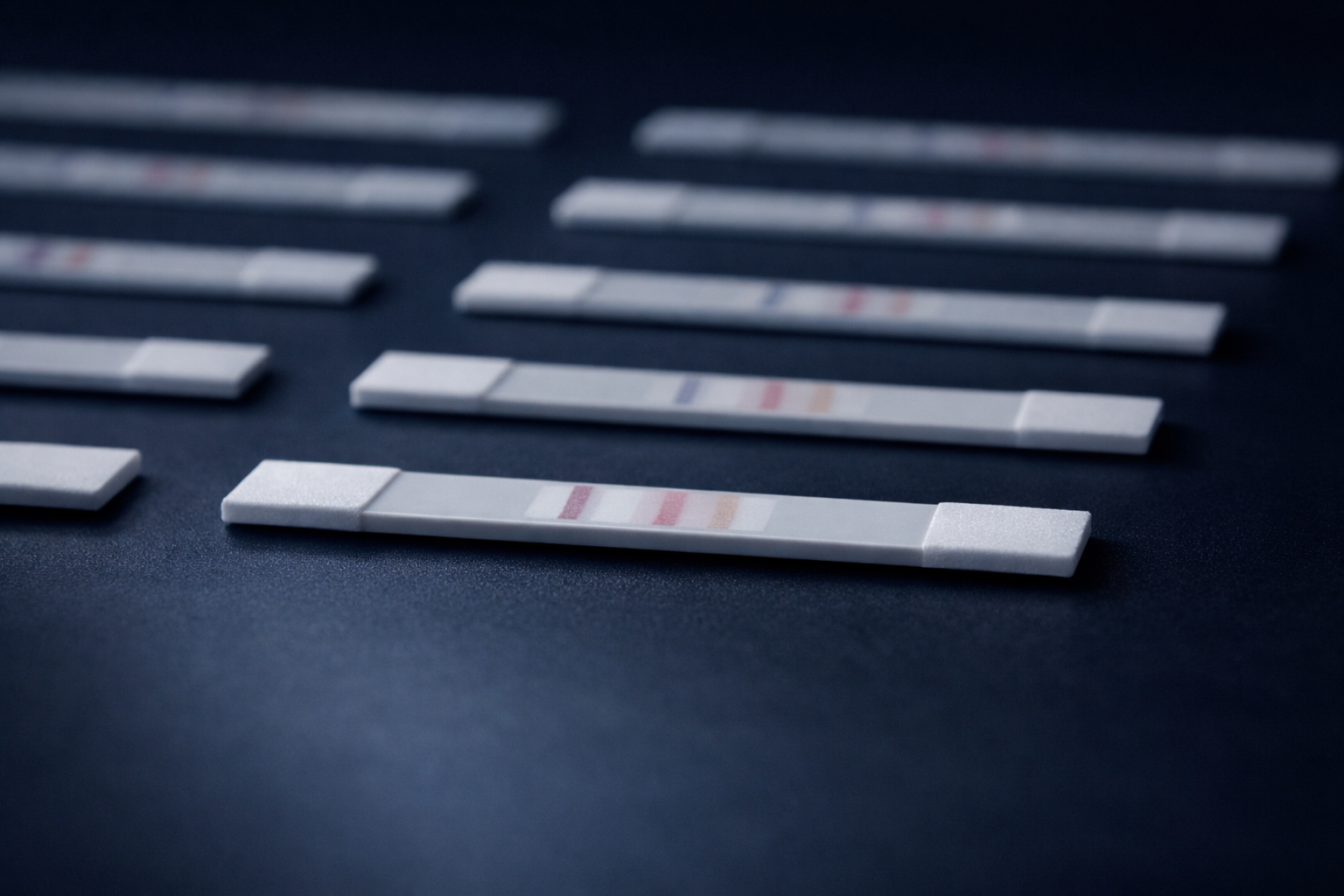
In the spring of 2023, a harm reduction program ordering drug-checking supplies had essentially one decision to make: how many fentanyl test strips. By April 2026, that same program is specifying five analytes (fentanyl, xylazine, medetomidine, nitazene, and benzodiazepine), deciding whether to add a combination strip, choosing between single-target and dual-target formats, and asking suppliers to document lot-to-lot sensitivity on drugs that did not exist in the supply two years ago.
The shape of the market has changed. The number of suppliers willing to ship all five, from a single U.S. manufacturer, has not.
What the last three years actually produced
Four developments account for most of the change. First, medetomidine. In May 2024, Philadelphia's municipal drug-checking program reported medetomidine in 29% of samples. By November of the same year it was 72%. By March 2026 it exceeded 80%. Toronto's Drug Checking Service tracked a parallel rise, from 11% in 2024 to roughly 78% in mid-2025. The veterinary sedative is now a dominant adulterant in both markets, with potency estimates placing it 100 to 200 times higher than xylazine.
Second, the Ohio Executive Order of October 2025. Governor DeWine's order explicitly authorized test strips for medetomidine, nitazene, xylazine, and benzodiazepines alongside fentanyl. It was the first state instrument to legalize the full multi-analyte portfolio in a single stroke, and it created a procurement template other states now cite.
Third, the federal funding reconfiguration. The ARPA cliff arrived December 31, 2024. State Opioid Response grants and opioid settlement funds absorbed the load. A SAMHSA guidance shift in July 2025 restricted some harm reduction line items while explicitly preserving reimbursement for drug-checking test strips, which shifted program mix more than it shifted program volume.
Fourth, the supplier landscape tightened. Two widely-used nitazene products were flagged for structural-class gaps in peer-reviewed work. A Harm Reduction Journal analysis published in August 2025 reported that a leading nitazene strip detected only 78% of tested analogs and produced false positives at caffeine concentrations of 300 micrograms per milliliter or higher, a level common in street heroin.
What the market is actually buying
The 2025 procurement data, read from state RFPs and program-reported distribution numbers, shows a clear hierarchy:
- Fentanyl strips remain the volume leader. New York has distributed more than 13 million fentanyl strips cumulatively through OASAS and partner organizations.
- Xylazine strips have become the second pillar. New York's 10 million cumulative xylazine strips and Wisconsin's September 2025 purchase of 131,000 units reflect the shift.
- Medetomidine strips are now a standing line item in Philadelphia's Department of Public Health and New York's Department of Health, which opened procurement in December 2025.
- Nitazene and benzodiazepine strips are purchased in smaller volumes, but the Ohio order and New Jersey's $130.7 million expansion to 46 harm reduction centers both name them in scope.
The pattern is not uniform. Some states are buying all five. Some are buying only fentanyl and xylazine. A growing number are asking a single question we hear repeatedly in procurement calls: can you ship all five from one manufacturer under one purchase order?
Where the gaps remain
Two gaps are visible from the procurement side. The first is the absence of a widely-validated commercial multi-strip (fentanyl, xylazine, medetomidine, nitazene, benzodiazepine) on a single substrate. Individual strips for each analyte exist. A consolidated four-or-five-analyte strip at scale does not, to our knowledge, exist in the North American supply chain as of April 2026.
The second gap is the structural-class detection problem in nitazene products. The desnitazene class has appeared in fatal overdoses and is not reliably detected by the leading nitazene strip on the market. Any program buying nitazene strips should ask the manufacturer to document which structural classes are covered.
The procurement question has moved from "which strip" to "which portfolio, from which manufacturer, with what lot-to-lot documentation."
The single-supplier argument
Our team manufactures all five analytes (fentanyl, xylazine, medetomidine, nitazene, benzodiazepine) in the United States. Several competitors manufacture one or two of these domestically. No other manufacturer, to our knowledge, offers the complete five-analyte portfolio from a single U.S. facility. That fact does not change procurement outcomes on its own. It changes what a single purchase order can do, what a single quality agreement can cover, and what a program can ask of one technical-support line when a field question comes in.
The back half of 2026 is already mapped. Ohio's post-Executive-Order RFP is expected mid-year. Allegheny County's rolling RFP runs through September. New Jersey's county-level procurements continue. Wisconsin's mail-delivery vendor work is in progress. The portfolio buyers are asking for is the five-analyte portfolio. The question is who can supply it.