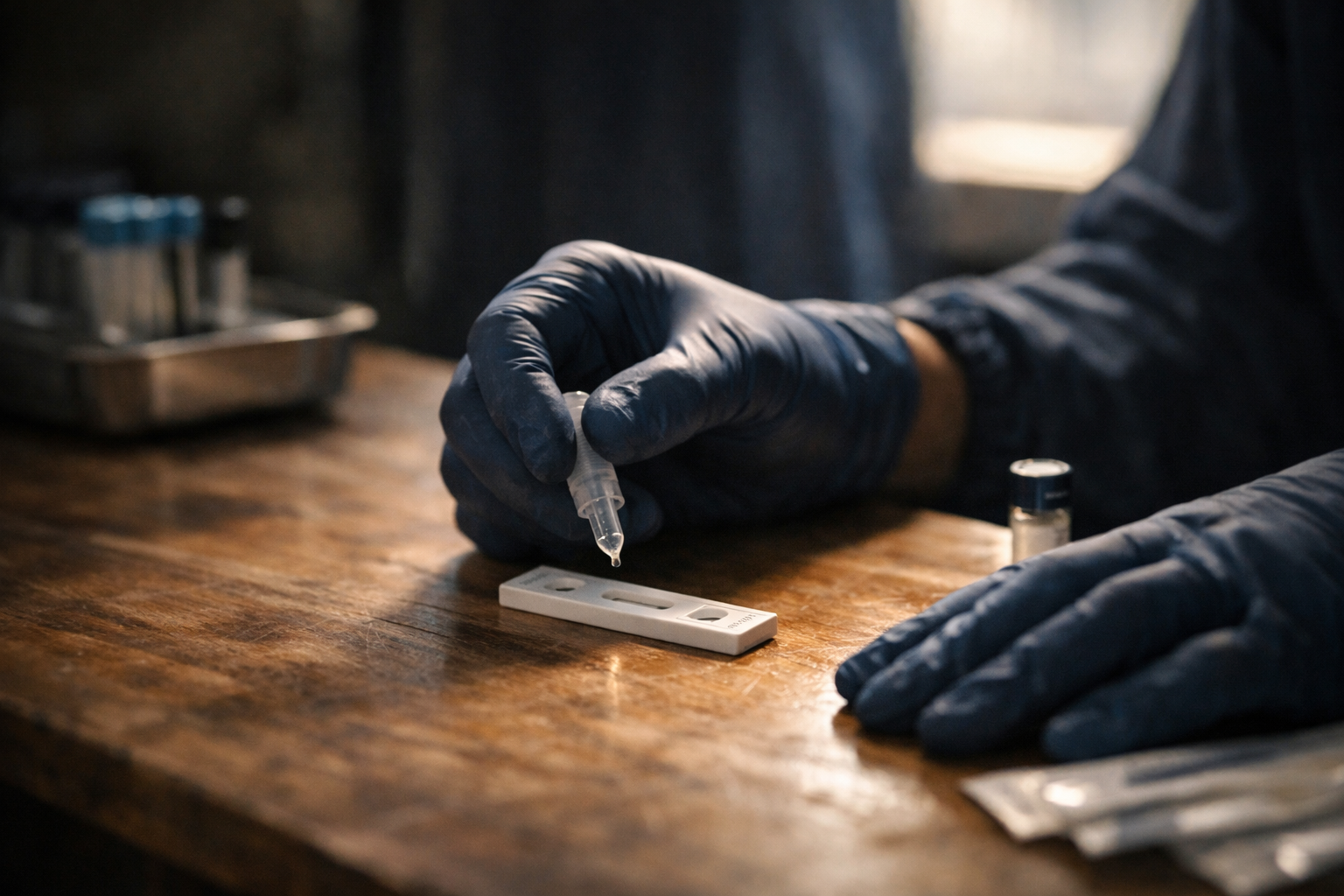
In May 2024, the Philadelphia Department of Public Health reported that medetomidine had been detected in 29% of drug samples analyzed through its municipal surveillance program. Six months later, that figure was 72%. By the time this post is published, it sits above 80%. Toronto's Drug Checking Service reported a roughly parallel curve, rising from 11% prevalence in early 2024 to near 78% by mid-2025.
No other adulterant we have seen has moved that fast. Xylazine took several years to climb to dominance in Philadelphia and elsewhere. Medetomidine took under two.
Why medetomidine is different
Medetomidine is a veterinary alpha-2 agonist, chemically related to xylazine but substantially more potent. The estimates in the published literature range, but a common figure places medetomidine at roughly 100 to 200 times the potency of xylazine on a per-milligram basis. For the people using the drug supply, that potency translates into three practical changes:
- Overdose profile shifts. Medetomidine produces deeper sedation and more pronounced bradycardia than xylazine, which means the clinical picture at hospital arrival can look different.
- Standard reversal is incomplete. Naloxone reverses the opioid component, not the medetomidine. Providers treating patients with combined fentanyl-medetomidine exposure have reported persistent sedation after opioid reversal.
- Withdrawal is different. The Philadelphia medical community documented more than 165 hospitalizations between September 2024 and January 2025 for what has been described as a medetomidine-specific withdrawal syndrome. Conventional opioid-withdrawal medications do not fully address it. The clinical reports point toward dexmedetomidine, a different alpha-2 agonist, as part of the treatment approach.
The chemistry was adjacent to xylazine. The clinical reality was not. Programs had to rebuild training materials in weeks, not quarters.
The testing gap
Because medetomidine is chemically related to xylazine, an early hope in the harm reduction community was that xylazine strips would cross-react with medetomidine at usable concentrations. They do not reliably do so. Structurally adjacent does not mean serologically identical, and field testing in 2024 confirmed that xylazine strips missed medetomidine at concentrations well above what programs needed to detect.
A dedicated medetomidine strip became the obvious need. Developing one required a target compound (medetomidine itself), a sensitivity threshold appropriate for street-drug concentrations, and specificity that would not throw a false positive on xylazine, clonidine, or any of the other alpha-2 compounds occasionally present. That work took most of 2024 in the commercial manufacturing world, with the first validated medetomidine strips reaching programs in the back half of that year.
How programs are using the strip
Two patterns have emerged in how harm reduction programs deploy medetomidine testing:
Surveillance-first deployment at places like Philadelphia DPH, Toronto's Drug Checking Service, and New York's Department of Health, where a subset of field samples is tested for medetomidine to maintain prevalence data that informs clinical preparedness.
Direct-user deployment at syringe service programs, harm reduction centers, and drop-in sites, where individual users test their own supply before use. Here the strip functions less as epidemiology and more as a decision tool: knowing medetomidine is present changes dosing, changes the reversal plan, and changes what the user tells the person they are using with.
Both deployment patterns require reliable lot-to-lot sensitivity, documented limits of detection, and the ability to ship the strip in volume. The New York Department of Health opened medetomidine procurement in December 2025. Philadelphia has been buying since mid-2024.
What this tells us about the next adulterant
The speed of medetomidine's emergence should be read as a pattern, not an exception. Synthetic nitazenes appeared on a similar curve in the UK and parts of continental Europe. Designer benzodiazepines like bromazolam have displaced older compounds in drug-checking data more quickly than most of us expected. The adulterant landscape is moving on a timescale that rewards manufacturers who can develop, validate, and ship a new strip within a year, and penalizes those who cannot.
For procurement officers, the implication is that a test-strip specification written in 2023 is now substantially incomplete. Fentanyl plus xylazine was a reasonable two-analyte baseline two years ago. Today's baseline appears to be four or five analytes, with room for whatever emerges next. Our team maintains all five analyte strips (fentanyl, xylazine, medetomidine, nitazene, benzodiazepine) under one U.S.-based manufacturing operation, which is the only reason we can respond to questions about "what you actually have in stock today" without calling four different suppliers.