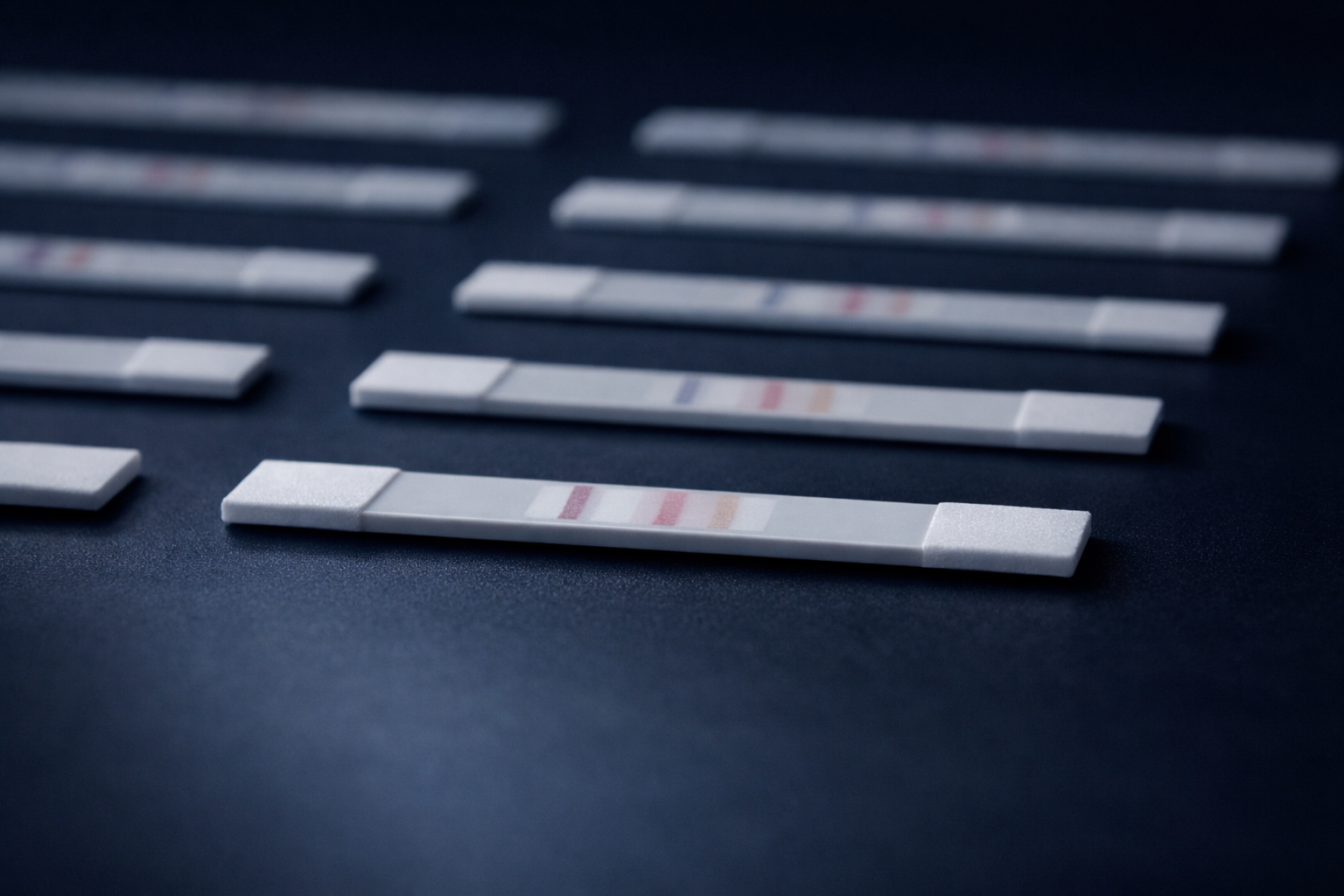
If you have spent any time procuring rapid drug-checking test strips at scale, you have probably noticed that two strips from the same manufacturer, ordered three months apart, do not always behave identically. Faint test lines that were sharp in one box may be hard to read in the next. Detection thresholds that worked at 200 nanograms per milliliter on lot A may quietly drift on lot B. Most programs catch this by accident, when a frontline worker complains that "the new strips look weird." That is not an acceptable QC posture for a public-health intervention.
The peer-reviewed harm-reduction literature has now closed this gap. In Harm Reduction Journal in August 2024, Fernando, Amate, Hayes, and colleagues from the laboratory of Marya Lieberman at the University of Notre Dame published a standardized two-phase quality-assurance framework specifically for fentanyl test strips marketed for drug checking. The paper, "A lot testing protocol for quality assurance of fentanyl test strips for harm reduction applications" (HRJ 21:152, 2024), is now the closest thing the field has to a community standard. Lieberman, who holds the Nancy Dee Professorship of Cancer Research at Notre Dame and was the 2025 recipient of the American Chemical Society Esselen Award for Chemistry in the Public Interest, has spent more than a decade building the analytical and field-evaluation work that this protocol grew out of. Any program buying strips at volume should know how it works.
The two-phase protocol, briefly
The protocol breaks lot evaluation into a Fast Screen and a Lot Quality Assurance Sampling (LQAS) stage. The screen is designed to catch obviously broken lots quickly, with minimal strip consumption. LQAS gives statistical confidence about whether the lot meets a defined acceptable failure rate.
Fast Screen tests ten strips at a fixed positive concentration (200 ng/mL fentanyl in deionized water) and ten strips against a deionized water blank. A lot that produces three or more errors across the twenty strips is rejected. This is a coarse filter and exists to prevent further LQAS time being spent on a lot that is clearly out of spec.
LQAS extends the test to twenty-five strips total at the same positive concentration. The lot is rejected if four or more of the twenty-five fail to produce an unambiguous positive line. The accept/reject thresholds were chosen to give 95 percent sensitivity at a five percent acceptable failure rate and 30 percent unacceptable failure rate. The math is detailed in the paper.
The interference panel that actually catches problems
A test that only confirms positive lines on a clean fentanyl solution misses the important question: does the strip throw false positives on substances commonly present in the unregulated supply? The Notre Dame protocol pairs the lot screen with an interference panel of seven compounds tested at three concentrations (2.0, 0.7, and 0.2 mg/mL). The panel covers four non-controlled adulterants commonly found in street samples (diphenhydramine, procaine, lidocaine, levamisole) and three controlled substances often co-present with fentanyl (methadone, methamphetamine, MDMA).
The 2024 paper documented five lots that produced false positives from diphenhydramine and several lots from BTNX that failed entirely due to faint or invisible test lines. These are the kinds of issues that would otherwise quietly degrade harm-reduction program credibility in the field, one frustrated user at a time.
The cost of one bad lot getting into a syringe service program is not the strips. It is the trust the program loses with the people it is trying to reach.
How DSG applies this
DSG has adopted the Fernando et al. lot screen as part of internal QA on lateral-flow drug-checking strips. Every production lot goes through a positive-and-blank screen at the published thresholds before it ships, and lots intended for institutional buyers also go through the LQAS extension. The interference panel is used on each new analyte introduced and re-checked when antibody sources change. Lot-level QC data is provided with each institutional order.
What buyers should be asking suppliers
If you are responsible for procuring drug-checking strips for a state health department, county program, syringe service program, or correctional intake program, three questions will tell you most of what you need to know about a supplier's lot QC posture:
- Do you screen each production lot at a defined positive concentration before it ships? If yes, what concentration, on how many strips, with what acceptable failure rate. If the supplier cannot answer that in one sentence, they are not screening.
- Do you maintain an interference panel against common adulterants and co-present compounds? If yes, which substances and at what concentrations. The Fernando et al. seven-compound panel is a reasonable minimum.
- Will you provide lot-level QC data with the order? A serious supplier will. A box of strips with a lot identifier and no provenance is a black box.
What changed in late 2025: AOAC SMPR 2025.002
The publication of AOAC SMPR 2025.002 and its companion validation protocol AOAC SP 2025.001 in late 2025 raised the floor again. Developed by AOAC INTERNATIONAL with NIST funding and a 52-member working group across academia, government, laboratories, and harm-reduction nonprofits, the standard establishes formal Standard Method Performance Requirements for strips detecting benzodiazepines, fentanyl, medetomidine, nitazenes, and xylazine in solid, liquid, and residue matrices. It is the most consequential community standard the harm-reduction strip market has ever had. Our internal QA program is aligned to both AOAC SP 2025.001 and the Notre Dame LQAS framework. Buyers should ask their suppliers the same question.
Further reading
- AOAC INTERNATIONAL (2025). SMPR 2025.002: Standard Method Performance Requirements for detection of benzodiazepines, fentanyl, medetomidine, nitazenes, and xylazine in selected drug products. PDF.
- AOAC INTERNATIONAL (2025). SP 2025.001: Standard Protocol for single- and independent-laboratory validation of methods for detection of benzodiazepines, fentanyl, medetomidine, nitazenes, and xylazine. overview.
- Fernando H, Amate A, Hayes KL, Whitehead HD, Desnoyers C, Uzobuife E, Denchfield MS, Whitelatch B, Lieberman M. (2024). A lot testing protocol for quality assurance of fentanyl test strips for harm reduction applications. Harm Reduction Journal 21:152. doi:10.1186/s12954-024-01058-y
- Lieberman M, Badea A, Desnoyers C, Hayes K, Park JN. (2024). An urgent need for community lot testing of lateral-flow fentanyl test strips marketed for harm reduction in Northern America. Harm Reduction Journal 21:115. doi:10.1186/s12954-024-01025-7
- The Notre Dame Paper Analytical Devices project, where the LQAS work originated, is documented at padproject.nd.edu.